Hillsborough County controls mosquitoes with traps, virus testing, larvicide and helicopter spraying, but the Aedes mosquitoes that carry dengue breed in small backyard containers the county cannot reach. The county says to empty and scrub buckets, pet dishes, flowerpots, vases, tires and toys at least twice a week, because the eggs survive above the waterline. A yard treatment adds to that habit but does not replace it.
What Hillsborough Mosquito Management Services does

The county runs a full mosquito program, and most of it happens out of sight. Hillsborough County Mosquito Management Services sets traps, keeps sentinel chickens and tests for viruses to see where mosquitoes are and what they carry. Crews remove breeding sites and treat larvae in standing water with Bti, a bacterial larvicide aimed at mosquito larvae.
When adult numbers or virus activity call for it, the county sprays Dibrom from helicopters flying at about 150 feet, after sunset or before sunrise. The county names two mosquitoes as the local dengue carriers: Aedes aegypti and Aedes albopictus. Both live close to people, and that is what makes them hard to control from the air.
Dengue in Hillsborough in 2026
As of Sept. 18, 2026, Hillsborough had about 134 locally reported dengue cases, roughly 88% of Florida's total, along with the county's first dengue-related death. Thirty-nine of those cases were reported in a single week, Sept. 6 to 12. Pinellas had 7 cases and Pasco had 2. WUSF reported Hillsborough as the center of the state's local cases, with aerial and ground spraying expanded against both Aedes species.
The county's dengue state of local emergency was extended on Oct. 1 to run through Oct. 8. Aerial treatments covered East Tampa, East Lake, Palm River and Bloomingdale on Oct. 4. South Tampa, Davis Islands and Palm River followed on Oct. 5, then Temple Terrace and the I-75 corridor on Oct. 7.
Questions about symptoms, testing or care belong with a doctor or the health department, not a pest company. This guide sticks to the mosquito side: where they breed and what helps around the house.
Seeing this at your place? We answer the phone around the clock.
Call (813) 471-5363What a helicopter cannot reach
Aerial spraying knocks down adult mosquitoes flying in open air at night or at first light. It is a strong tool in an outbreak, but it has limits that matter in a backyard.
Aedes mosquitoes do not keep the night shift. The county notes they bite during the day and at night, with peaks near sunrise and sunset. Between meals they rest in shade, under leaves, inside dense shrubs and under patio furniture, where spray drifting down from 150 feet barely reaches.
Their eggs are the bigger gap. Aedes lay eggs on the inside walls of small containers just above the waterline: buckets, pet dishes, flowerpots and their saucers, vases, old tires and toys left in the grass. The eggs stick there and survive after the water dries. The next rain floods them and a new batch hatches. No spray, from the air or the ground, kills eggs sitting inside a bucket on your patio.
Containers, twice a week, all rainy season
The county's advice is simple: empty and scrub containers at least twice a week. Scrubbing matters as much as emptying. Tipping out a pet dish leaves the eggs stuck to the wall, ready for the next fill.
Tampa's rainy season makes the habit hard to keep. From late May through October, afternoon thunderstorms roll through almost every day, and about two-thirds of the year's rain falls from June to September. A saucer you emptied on Monday can be full again by Tuesday evening.
Make a short route and walk it on the same two days each week. Check the obvious containers first, then the places people forget: the tarp over the grill, the kayak, the wheelbarrow, a child's sand pail, the drip tray under a potted plant on the lanai, and the gutter corner that never drains. Turn over what you can, store what you do not use, and drill drain holes in anything that has to stay outside.
Where a yard mosquito treatment fits
A professional yard treatment works on the parts of the cycle the helicopter misses. We treat the shaded foliage, hedges and undersides of decks where adult mosquitoes rest during the day, and we walk the property looking for standing water you may not know about. Water that cannot be dumped, such as a decorative pond or a low corner of a drain, can be treated with a larvicide.
None of that replaces the twice-a-week container check. A barrier on the hedges keeps working only while new mosquitoes are not hatching from a bucket a few steps away. We tell you what we found on each visit so the containers can be handled between treatments.
Published Florida figures put mosquito control at $150 to $400 one-time; $600 to $1,500 annual. A single visit before a gathering costs less than a season of treatments, and the size of the yard and the amount of dense shade move the price. See mosquito control for how a visit runs.
Screened lanais and pool cages during an outbreak
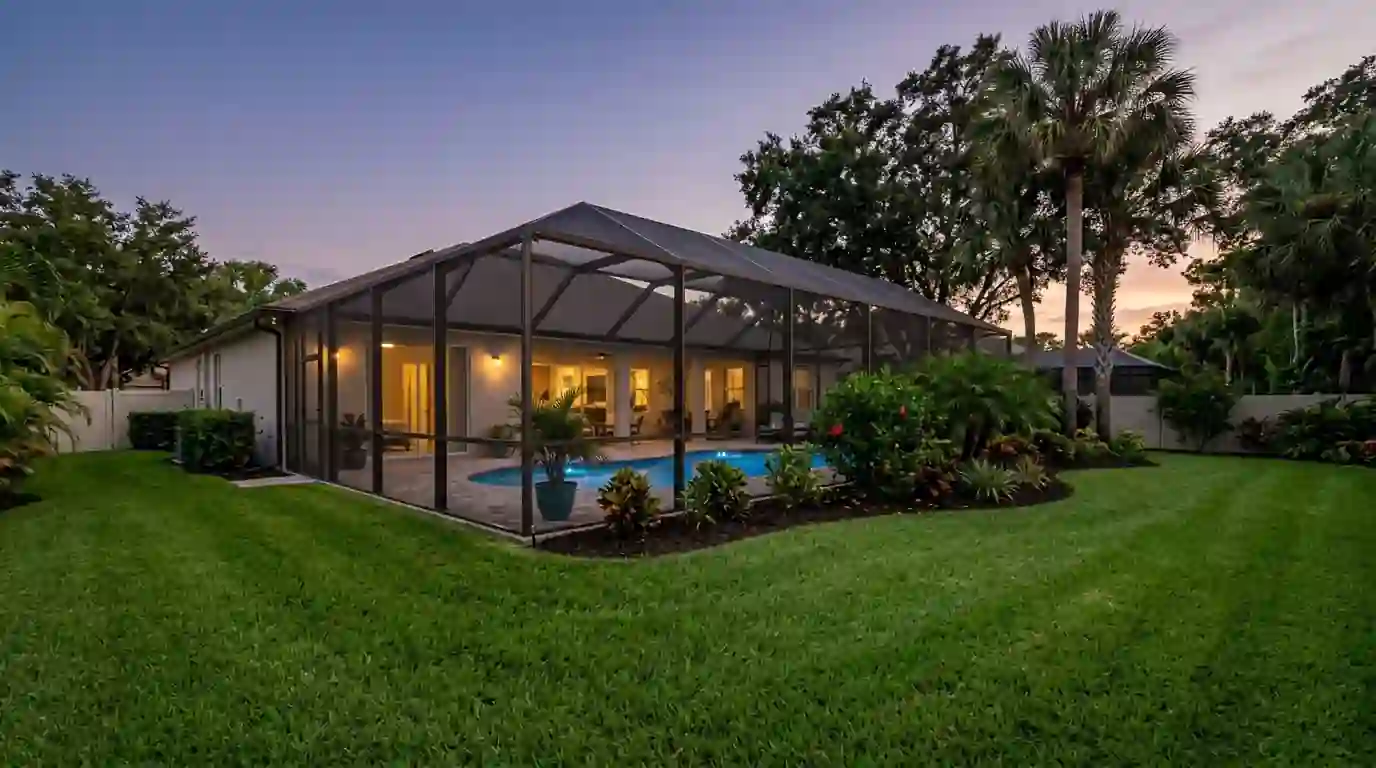
A screened enclosure keeps most mosquitoes out, but only if the screen is whole and nothing inside is breeding them. A torn panel near the door, a gap under the screen door, or a plant saucer sitting inside the cage undoes the protection.
Walk the lanai with the same eye as the yard. Patch tears, check the door sweep, and empty anything holding water inside the cage. A pool that is kept chlorinated and circulating is not the problem. A covered spa with rainwater pooled on the cover can be.