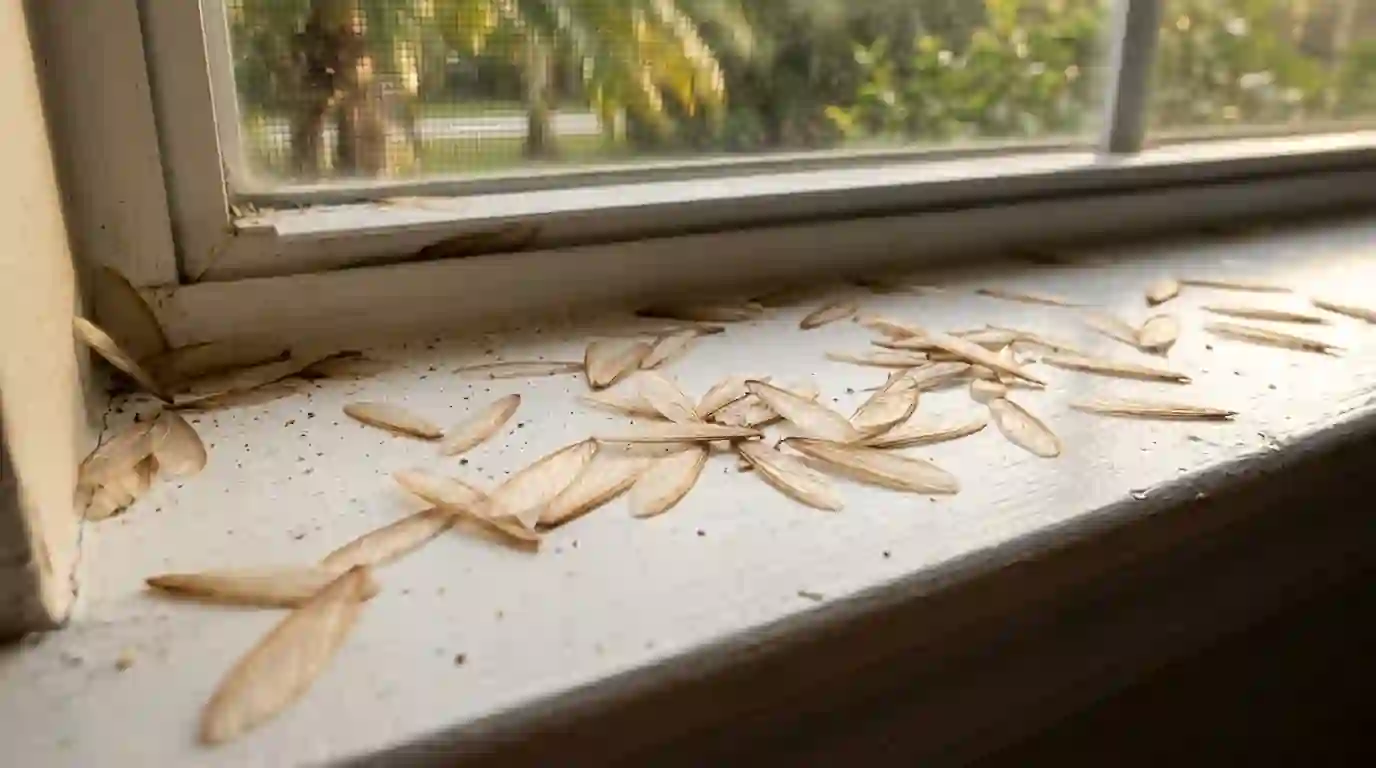
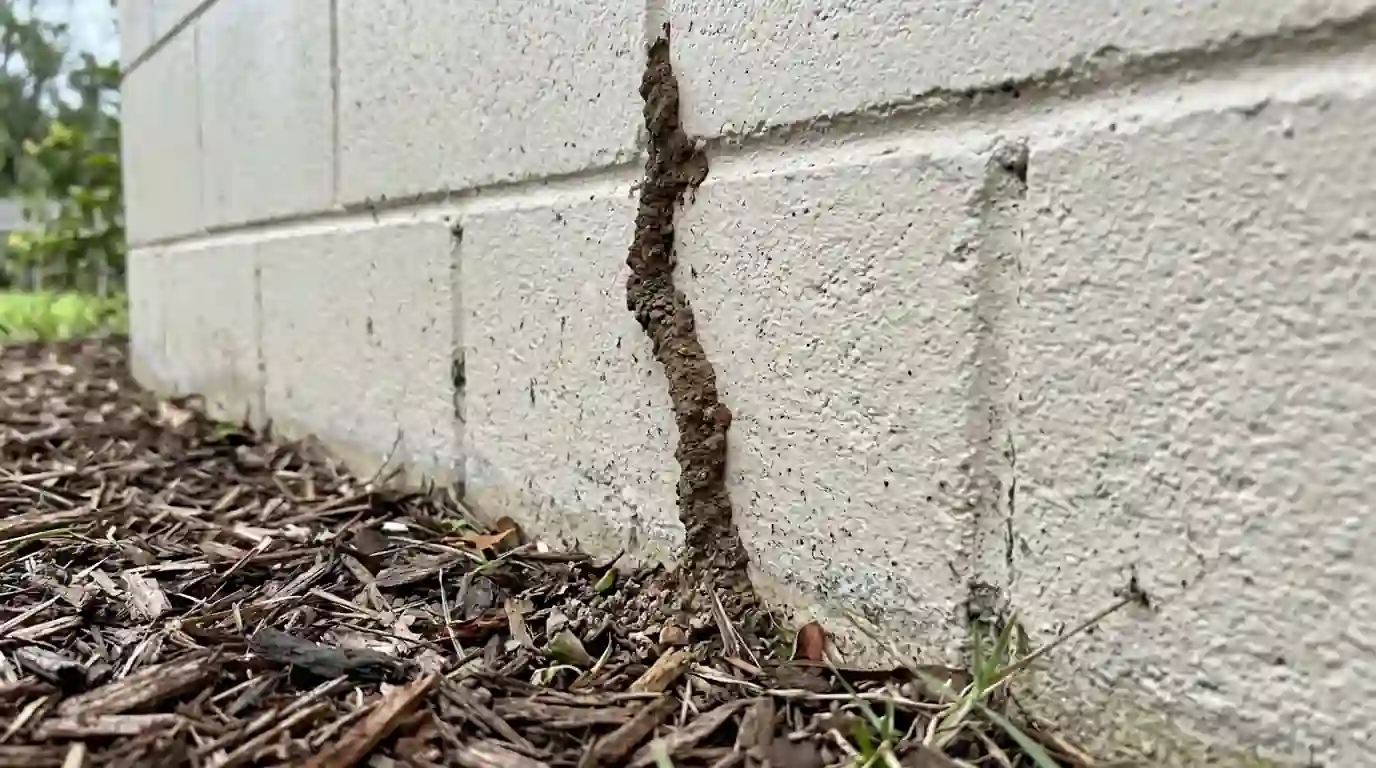
In Tampa homes, drywood termites leave piles of tiny six-sided pellets below 1-2 mm kick-out holes, while subterranean termites build mud tubes up from colonies in the soil. Drywood colonies live entirely inside dry wood and are handled with spot treatment or tenting. Subterranean colonies need soil, so they are treated at the ground with a soil barrier or bait stations.
Pellets on the sill or mud on the slab?
Drywood termites push their droppings out of the wood through kick-out holes only 1 to 2 mm across, and the pellets collect in a small pile below. Each pellet is hard and six-sided. A pile on a windowsill, a baseboard or the floor of a cabinet often looks like coarse ground pepper, and the color tends to match the wood being eaten. Sweep it up, then look again in a week or two. A fresh pile in the same place means the colony is still feeding.
Subterranean termites leave no pellets on the floor. They use their droppings as building material, mixing them with soil and saliva into mud tubes, and they keep those tubes closed because the workers dry out in open air. The usual first sign is a brown tube about the width of a pencil or wider, climbing a foundation wall, a slab edge in the garage, a pier or the back of a baseboard.
Broken wood gives a second clue. Drywood galleries are clean and smooth and cut across the grain, with pellets packed into some chambers. Subterranean damage follows the softer layers of the grain and is lined with soil, so the wood looks layered and dirty when you split it.
How each one lives, from the West Indian drywood to the Formosan
The West Indian drywood termite never touches the ground. A colony begins when a pair of swarmers seals itself into a crack in dry wood, and it stays there for life, in framing, trim, furniture or even a boat. The species has spread along the Florida coasts and does its worst in older buildings, where colonies have had years to multiply and spread to new boards.
Subterranean termites are built the other way around. Native eastern subterranean termites live statewide in colonies of 100,000 to 1 million and forage up to 150 feet from the nest, coming up through tubes to reach wood. Formosan subterranean termites, found across Florida and mostly in dense urban areas, pack wall voids with carton nest material and can hollow out living trees. A Formosan colony can also set up above ground where a roof leak or a dripping pipe keeps wood wet, so a moisture problem and a termite problem often turn up together.
Tampa has a third subterranean species to watch. In March 2023, UF/IFAS confirmed that Asian subterranean termites are established in South Tampa, the northernmost known infestation of this tropical termite in Florida. Researchers think it had been there 7 to 10 years before Hillsborough pest control operators sent in the samples that confirmed it, and they warn that its colonies hollow out large, healthy trees.
Pellets on a sill or mud on the slab? Describe it on the phone, we answer 24/7.
Call (813) 471-5363Why a tent does nothing for a colony in the soil
Treatment follows biology. A drywood colony is sealed inside the wood it eats, so the product has to get into that wood. Where the colony is confined to one frame, a run of trim or a piece of furniture, a spot treatment drills into the galleries and injects foam, dust or liquid right where the termites are feeding. Where pellets keep showing up in several rooms or in the attic, the house is tented with gas-tight tarps and sulfuryl fluoride is released. Nearly all whole-structure fumigation in Florida is aimed at this one termite.
Subterranean termites are a different target. The colony sits in the soil, often outside the footprint of the house, and only foragers come up to feed. A tent would kill the workers in the walls that day and leave the colony untouched under the yard. That is why subterranean work happens at ground level: a liquid termiticide trenched and rodded into the soil along the foundation, drilled through slab edges where needed, or bait stations set around the house that foragers feed on and carry back to the nest.
Some houses have both. A pellet pile under a window and mud tubes in the garage are two separate problems, and a plan for one does not cover the other.
The big-headed ant tube that passes for termite mud
Not every tube on a foundation is termite work. Big-headed ants push up piles of loose, sandy soil where a lawn meets a sidewalk or driveway, and they nest under slabs and along foundations. As they forage they build fragile debris tubes up walls and along baseboards, and these are easy to mistake for termite tubes. Pest control operators call it the most pervasive nuisance ant in parts of Florida, so the mix-up comes up often.
A few quick checks sort it out. Termite tubes are firm and packed, a broken section usually shows pale, soft-bodied workers inside, and the gap is often rebuilt within days. Ant tubes crumble at a touch, look more like loose sand than mud, and have small reddish-brown ants running along them, some with heads far too big for their bodies. Little mounds of sand at the edge of the pavement nearby point to ants as well.
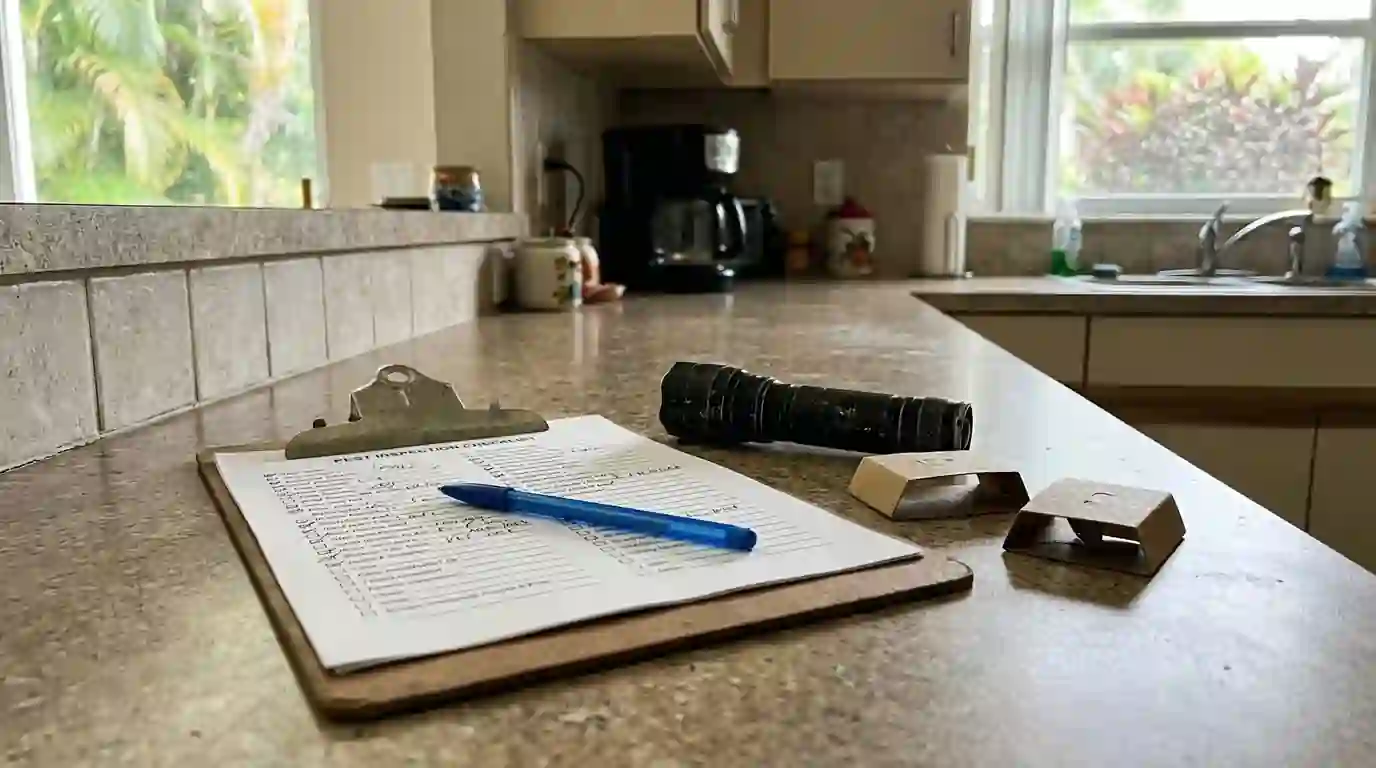
Not sure which you have? Take a photo before you knock anything down, and save a few of the insects in a sealed bag or on a strip of clear tape. That is usually enough for us to tell you which one you are dealing with.
What each treatment costs in published Florida figures
Florida cost guides list a localized drywood spot treatment at $250 to $1,200 and a whole-house drywood tent fumigation at $1,200 to $5,000. The gap between those two numbers is why the inspection matters so much: confirming that a colony really is confined can save a move-out and a far larger bill. Our tenting cost guide covers what moves the tent price.
For subterranean termites, the same Florida source puts a one-time treatment at $1,500 to $3,500. The length of the foundation, the slab type and any drilling through a patio, garage floor or driveway move that number, and a bait system adds ongoing monitoring visits after the install.
These are planning ranges from published guides, not quotes. You hear our price after the inspection, before any work is scheduled.